Guide
Commercial Ice Machine Troubleshooting, Symptom by Symptom
Commercial ice machine troubleshooting in the order failures happen: power, water, bin, airflow and board codes, plus food-safety limits and when to call.
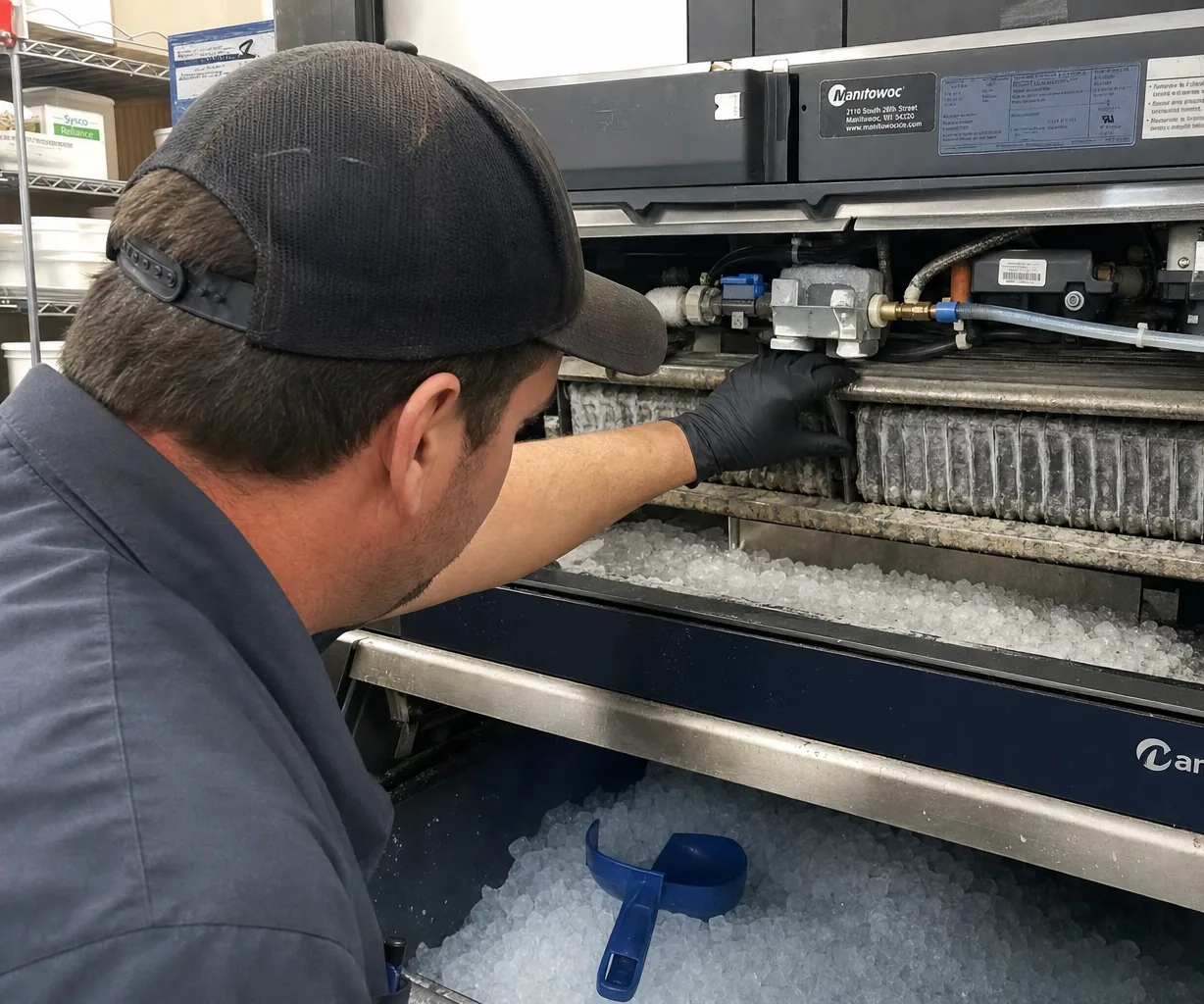
Commercial ice machine troubleshooting goes fastest as five checks in a fixed order: power, water supply, the bin and curtain, airflow around the condenser, then the light, beep pattern or code on the control board. If those checks don’t bring the ice back, a diagnostic visit is typically $95–$165 and an ice machine repair typically runs $350–$1,500, with the firm quote given on site after diagnosis.
Symptoms usually arrive in order: the bin runs low, cycles slow down, then the machine stops and shows a code. Catch it early and you plan the service call instead of buying bagged ice mid-dinner. In Port Chester, a show night at the Capitol Theatre fills the bars and restaurants around it, which is exactly when a slow machine becomes an empty bin.
What should staff check first when the ice machine stops?
- Power. Check for a lit display, the breaker and the plug, and make sure the switch is set to make ice, not off, clean or drain.
- Water. Confirm the supply shut-off valve is fully open and the line isn’t kinked. A clogged filter starves the machine like a closed valve.
- Bin and curtain. A full bin, or bridged ice holding the curtain open, stops production on purpose. Clear jams with a clean scoop, never a tool against the evaporator.
- Airflow. Boxes against the grille or a lint-covered condenser make an air-cooled machine run hot.
- The code. Write down the exact light, beeps or code before anyone resets the machine, because a reset can clear it.
Why is the machine running but getting no water?
The board usually spells it out. On Manitowoc undercounter models, a red Service light with Limit 3 means no water was sensed at 4 minutes into the freeze. Hoshizaki modular flakers beep once every 5 seconds when the upper float switch stays open more than 90 seconds after the water valve opens; that alarm resets once water returns. If the valve is open, the filter is fresh and the alarm keeps returning, suspect the inlet water valve, float or water pump, which is technician work.
What do the lights, beeps and codes mean?
| Symptom or code | Likely cause | What staff can check | When to call a technician |
|---|---|---|---|
| Dark display | Tripped breaker, loose plug, switch off | Breaker, cord, switch | If the breaker trips again |
| Manitowoc red Service light, Limit 3 | No water at 4 minutes of freeze | Valve, filter, kinked line | If water is on and it repeats |
| Hoshizaki flaker, 1 beep every 5 seconds | Low water | Water supply and filter | If it returns after water is restored |
| Hoshizaki cuber, 3 beeps | Freeze ran past the timer twice in a row | Water running nonstop to the drain | Same day |
| Hoshizaki cuber, 1 beep | Evaporator over 127°F (53°C) | Hot water line connected by mistake | Same day |
| Hoshizaki flaker, 4 beeps | Third high-pressure trip within an hour | Power off and left off | Right away |
| Indigo NXT E12 | Curtain switch open over 24 hours | Curtain hangs freely, no jam | If the curtain is fine |
| Indigo NXT E19, E20 or E31 | Ice thickness probe, water system, Safe Mode | Note the code, check water | Within the 72-hour window |
Why is the ice thin, slow or stuck in harvest?
The board counts long cycles before it shuts down. Manitowoc undercounter units trip Limit 1 after six consecutive 45-minute freezes and Limit 2 after three consecutive 7-minute harvest-and-thaw cycles. A Hoshizaki crescent cuber’s 3 beeps point to a float switch stuck closed, a leaking inlet water valve or a pump that isn’t pumping. Its 1-beep alarm is a harvest problem such as a stuck hot gas valve, hot water reaching the unit or a shorted thermistor.
Heat is the cause staff can fix. A dirty condenser or a hot back room stretches every cycle and can trip a Hoshizaki flaker’s high-pressure switch; 3 beeps mean one or two trips within an hour, reset automatically.
How long can you keep serving, and is the ice still safe?
Treat ice as food. Food Code 4-602.11 requires ice bins and the enclosed parts of an ice maker to be cleaned as often as the manufacturer specifies, or often enough to keep soil and mold from building up. After codes, leaks or a warm stretch, empty and sanitize the bin before the next service.
Your waiting time depends on the fault. If the ice thickness or water level probe fails on a Manitowoc Indigo NXT, Safe Operation Mode keeps making ice for up to 72 hours while the display flashes an alert, then the board goes to standby and shuts off. Book the call on day one, not at hour 71.
When should you call a technician?
Try one clean restart. On an Indigo NXT stopped by a service fault, press On/Off until the display reads Off, then press it again for Making Ice. If it stops again, the fault has repeated and needs service. Repeated resets only keep a failing machine limping.
Call right away for a high-pressure lockout, hissing or oily spots near the refrigerant lines, water on the floor or a breaker that trips twice. Our ice machine repair service covers Port Chester, Rye Brook, Rye, Harrison and Mamaroneck, and repair pricing lists typical ranges. Port Chester Commercial Appliance Repair is an independent service, not manufacturer-authorized. Call (914) 537-0917 with a data-plate photo and the code, and mention a struggling reach-in nearby; that heat also hurts commercial refrigeration.
Frequently asked questions
Why is my commercial ice machine getting no water?
Usually the supply valve is partly closed, the filter is clogged or the line is kinked. If water reaches the machine and the low-water alarm persists, the inlet valve, float switch or pump needs a technician.
Can I reset a commercial ice machine myself?
Yes, once. If the same fault returns, stop and call, because some lockouts, such as four beeps on a Hoshizaki flaker, mean the power should stay off.
Does an electric ice machine need more than power and water?
Yes, it also needs a working drain, clear airflow and, on remote-condenser models, a healthy outdoor unit. Indigo NXT boards flag that last one as E16, a remote condensing unit fault.